Introduction
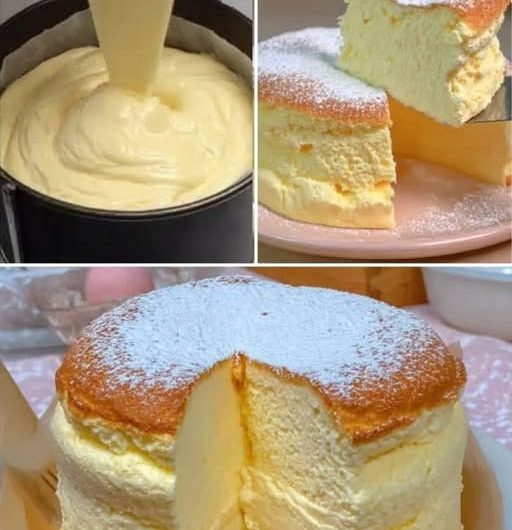
Cloud cake is an exceptionally light, soft, airy cake with a delicate crumb and a texture that feels almost weightless when you eat it. The name comes from its fluffy interior, which is created by carefully whipping egg whites and gently folding them into the batter. When prepared correctly, the finished cake is tender, moist, and springy, with a smooth top and a subtle sweetness.
This recipe makes a tall, soft cloud cake that is excellent for afternoon tea, birthdays, family gatherings, or simply serving as a homemade dessert. It can be enjoyed plain, dusted with powdered sugar, topped with whipped cream, or served with fresh fruit.
Ingredients
For the cake
8 large eggs, separated, at room temperature
150 grams granulated sugar
90 grams cake flour
30 grams cornstarch
1/4 teaspoon salt
60 milliliters whole milk
50 milliliters neutral vegetable oil
1 teaspoon pure vanilla extract
1 teaspoon fresh lemon juice
1/2 teaspoon finely grated lemon zest, optional
1/4 teaspoon cream of tartar, optional
For the topping
250 milliliters cold heavy whipping cream
30 grams powdered sugar
1 teaspoon vanilla extract
Fresh strawberries, blueberries, raspberries, peaches, or other fruit, optional
Powdered sugar for dusting, optional
Equipment
One 20-centimeter round cake pan
Baking parchment
Two large mixing bowls
One medium mixing bowl
Fine-mesh sieve
Electric hand mixer or stand mixer
Rubber spatula
Whisk
Measuring cups and spoons
Kitchen scale, preferably
Cooling rack
Long serrated knife, if you want to slice the cake into layers
Preparing the Oven and Pan
Begin by preparing the oven before making the batter because the cake should go into the oven soon after the egg whites have been incorporated.
Preheat the oven to 160°C conventional heat. If you are using a fan-assisted oven, use approximately 145°C to 150°C because fan ovens generally bake cakes more quickly.
Place the oven rack in the lower-middle position.
Line the bottom of a 20-centimeter round cake pan with parchment paper. Do not heavily grease the sides of the pan. The batter needs some grip on the sides of the pan as it rises. If the sides are completely greased, the cake can have difficulty climbing upward and may shrink more after baking.
If your pan has a removable bottom, make sure it fits tightly. If there is any possibility of batter leaking, wrap the outside bottom of the pan with aluminum foil before filling it.
Separating the Eggs
Separate the eggs carefully while they are cold, then allow the separated eggs to come closer to room temperature before making the batter.
The egg whites must be completely free of egg yolk. Even a small amount of yolk can make it more difficult to whip the whites properly because the fat in the yolk interferes with the formation of a stable foam.
Place the egg yolks in one bowl and the egg whites in another large, clean, dry bowl.
Make sure the bowl and beaters used for the egg whites are completely clean and free from grease.
If possible, use a glass or metal bowl for whipping the whites.
Making the Egg Yolk Mixture
Place the egg yolks in a large mixing bowl.
Add approximately 50 grams of the granulated sugar and whisk until the mixture becomes slightly lighter in color.
Add the milk and vegetable oil.
Whisk gently until everything is combined.
Add the vanilla extract and, if using it, the lemon zest.
Continue whisking until the mixture is smooth.
Do not whip the yolks excessively. The goal is simply to combine the ingredients thoroughly and create a smooth liquid mixture.
Preparing the Dry Ingredients
Place the cake flour, cornstarch, and salt into a fine-mesh sieve.
Sift the ingredients into the bowl containing the egg yolk mixture.
Sifting is especially useful for this recipe because the cake depends on a very light texture. Flour that contains lumps can be difficult to incorporate without overmixing.
Use a whisk to gently combine the flour mixture with the yolk mixture.
Whisk only until the batter becomes smooth.
Do not continue mixing once the flour has disappeared.
Overmixing at this stage can develop gluten and make the cake heavier and less delicate.
The finished yolk batter should be smooth, fairly thick, and free from visible pockets of flour.
Whipping the Egg Whites
Now begin whipping the egg whites.
Add the lemon juice or cream of tartar if using it.
Start mixing the egg whites on low speed until they become foamy.
Once the whites are covered with fine bubbles, increase the mixer to medium speed.
Gradually add the remaining granulated sugar.
Do not add all of the sugar at once.
Adding the sugar gradually helps produce a more stable meringue.
Continue whipping until the egg whites become glossy and hold firm peaks.
When you lift the beaters, the meringue should form a peak that stands upright with only a slight bend at the very tip.
Do not whip the egg whites until they become dry, grainy, or clumpy.
This is one of the most important steps in the entire recipe.
The whipped egg whites contain thousands of tiny air bubbles. These bubbles expand in the oven and help give cloud cake its characteristic lightness.
If the whites are under-whipped, the cake may not rise sufficiently.
If they are severely over-whipped, they can become difficult to fold into the batter and may lose their ability to create a smooth, stable structure.
Combining the Egg Whites and Yolk Batter
Take approximately one-third of the whipped egg whites and add them to the egg yolk batter.
Use a rubber spatula to gently fold the mixture together.
At this stage, you can mix slightly more firmly because the first portion of meringue is mainly being used to lighten the yolk mixture.
Once incorporated, add another portion of the whipped egg whites.
Fold gently.
Finally, add the remaining egg whites.
Fold slowly and carefully.
To fold, slide the spatula down through the center of the mixture, scrape along the bottom of the bowl, and bring the batter upward and over the top.
Rotate the bowl as you work.
Continue until no large streaks of egg white remain.
Do not stir vigorously.
Do not beat the batter.
Do not repeatedly scrape the spatula around the bowl in a circular motion.
The goal is to preserve as much of the air in the meringue as possible.
The finished batter should be smooth, light, and airy.
Filling the Cake Pan
Pour the batter into the prepared cake pan.
Hold the pan a few centimeters above the countertop and gently tap it once or twice.
Do not repeatedly bang the pan because excessive tapping can remove the air that you carefully incorporated into the batter.
Use a spatula to gently smooth the surface.
If you see a large bubble near the surface, you can carefully pop it with the tip of the spatula.
Baking the Cloud Cake
Place the cake pan in the preheated oven.
Bake at 160°C for approximately 45 to 55 minutes.
The exact baking time depends on the size and material of your pan, your oven, and the moisture content of the cake.
Try not to open the oven during the first 35 minutes.
A sudden drop in temperature can cause a delicate foam-based cake to collapse.
After approximately 40 minutes, you can begin checking the cake.
The top should be golden and lightly browned.
The center should look set rather than liquid.
Gently press the center with a fingertip.
It should spring back rather than remain deeply indented.
A wooden skewer inserted into the center should come out clean or with only a few moist crumbs attached.
If the top is becoming dark before the center is finished, loosely cover the cake with aluminum foil and continue baking.
Do not press the foil directly onto the cake.
Cooling the Cake
When the cake is completely baked, remove it from the oven.
Place the pan on a cooling rack.
Allow the cake to cool for approximately 10 minutes.
Run a thin knife carefully around the sides of the cake if necessary.
Remove the cake from the pan.
Place it directly on the cooling rack.
Allow it to cool completely before cutting.
Do not slice the cake while it is very hot.
The internal structure is still setting during the cooling process, and cutting it too early can make the crumb appear gummy or cause the cake to collapse.
Preparing the Whipped Cream
While the cake cools, prepare the topping.
Pour the cold heavy whipping cream into a chilled mixing bowl.
Add the powdered sugar and vanilla extract.
Whip on medium speed until the cream thickens.
Continue whipping until it reaches soft-to-medium peaks.
Do not overwhip the cream.
The cream should remain smooth and spreadable.
If you whip it too far, it can become grainy and begin turning into butter.
Decorating the Cake
Once the cake is completely cool, place it on a serving plate.
You can serve it exactly as it is for a simple dessert.
For a more traditional dessert-style presentation, spread whipped cream over the top.
Add fresh strawberries, blueberries, raspberries, sliced peaches, or other fruit.
Dust the finished cake lightly with powdered sugar.
For a more elaborate cake, slice the cake horizontally into two or three layers using a long serrated knife.
Spread whipped cream between the layers.
Add a thin layer of fruit.
Place the next cake layer on top.
Repeat if making multiple layers.
Cover the top with additional whipped cream.
Add fruit just before serving.
How to Get an Extremely Fluffy Cloud Cake
The first important factor is the eggs.
Use fresh eggs and separate them carefully.
The whites should contain no visible yolk.
Room-temperature egg whites generally whip efficiently and produce a good volume.
The second important factor is the sugar.
Add the sugar gradually while whipping the egg whites.
The third factor is folding.
The egg whites are responsible for much of the cake’s airy structure, so aggressive mixing can destroy the bubbles.
Fold slowly and deliberately.
The fourth factor is oven temperature.
An oven that is too hot can cause the cake to rise rapidly and then collapse.
An oven that is too cool can leave the center underbaked.
A moderate temperature is therefore important.
The fifth factor is cooling.
Allow the cake to cool gradually.
Avoid placing a very hot cake immediately in a cold or drafty environment.
Why Cloud Cake Sometimes Collapses
Cloud cake can collapse for several reasons.
One common reason is underbaking.
If the outside looks finished but the center is still wet, the cake can sink after removal from the oven.
Another reason is overmixing.
If too much air is knocked out during folding, the cake may not rise enough.
Another possibility is an unstable meringue.
Egg whites that were contaminated with yolk or grease may not whip properly.
Adding sugar too quickly can also affect the texture of the meringue.
Opening the oven too early can cause a sudden temperature change and encourage the cake to collapse.
Using a pan that is too large can also produce a cake that is relatively short and fragile.
Why the Cake May Become Dense
A dense cloud cake usually means that too much air was lost before baking or that the ingredients were mixed too heavily.
Make sure the egg whites reach firm, glossy peaks.
Make sure the flour is sifted.
Avoid vigorous stirring after adding the meringue.
Do not allow the batter to sit for a long time before baking.
Put it into the oven relatively soon after mixing.
Why the Cake May Crack
A small crack on top is not necessarily a problem.
A crack can occur when the oven temperature is slightly too high or when the cake rises quickly.
If you want a very smooth surface, experiment with lowering the oven temperature slightly and extending the baking time.
However, every oven behaves differently, so avoid making dramatic temperature changes.
Why the Cake Shrinks
Some shrinking is normal in an airy sponge-style cake.
However, excessive shrinking can indicate underbaking, an unstable meringue, excessive moisture, or a sudden temperature change.
Make sure the center is fully baked before removing the cake.
Also avoid opening the oven repeatedly during baking.
Flavor Variations
Vanilla Cloud Cake
Use the basic recipe exactly as written and increase the vanilla extract to 1 1/2 teaspoons.
This produces a clean, sweet vanilla flavor.
Lemon Cloud Cake
Add 1 to 2 teaspoons of finely grated lemon zest to the egg yolk mixture.
You can also add a small amount of fresh lemon juice to the whipped cream topping.
Avoid adding excessive liquid to the cake batter because extra liquid can change the structure.
Orange Cloud Cake
Replace part of the milk with fresh orange juice and add finely grated orange zest.
For the strongest orange aroma, use freshly grated zest.
Chocolate Cloud Cake
Replace approximately 20 grams of the cake flour with unsweetened cocoa powder.
Sift the cocoa powder together with the flour and cornstarch.
Because cocoa powder can make cakes slightly drier, do not add excessive amounts.
Strawberry Cloud Cake
Bake the plain cloud cake.
Cool completely.
Cover with whipped cream and fresh sliced strawberries.
For an elegant finish, arrange thin strawberry slices around the top.
Mango Cloud Cake
Use the plain cake as the base.
Prepare whipped cream and spread it over the cake.
Add thinly sliced ripe mango.
You can also place a thin layer of mango puree between two cake layers.
Serving Suggestions
Cloud cake is excellent with fresh fruit.
It can be served with strawberries and whipped cream.
It can be served with a light dusting of powdered sugar.
It can be served alongside tea or coffee.
It can also be paired with berries and a small amount of fruit sauce.
For a celebration, decorate it with whipped cream and colorful fruit.
For a simple homemade dessert, serve a plain slice while the cake is completely cooled.
Storage
Store the finished cake in an airtight container.
If the cake has whipped cream or fresh fruit on top, refrigerate it.
A plain cake can generally remain at room temperature for a short period if the environment is cool and dry, but refrigeration is preferable for longer storage.
A decorated cake containing whipped cream should be refrigerated.
Allow refrigerated cake to sit at room temperature for approximately 10 to 20 minutes before serving if you prefer a softer texture.
Important Tips for Beginners
Measure the flour accurately.
A kitchen scale is preferable to measuring flour by volume.
Do not pack flour tightly into a measuring cup.
Use clean equipment for the egg whites.
Separate the eggs carefully.
Keep yolk away from the whites.
Add sugar gradually to the egg whites.
Stop whipping when the meringue forms firm, glossy peaks.
Sift the dry ingredients.
Do not overmix the yolk batter.
Fold the egg whites gently.
Do not repeatedly beat the batter.
Preheat the oven completely.
Avoid opening the oven during the early part of baking.
Make sure the center is fully baked.
Allow the cake to cool before slicing.
Use a serrated knife for clean slices.
Full Recipe at a Glance
Use 8 large eggs, separated.
Use 150 grams granulated sugar.
Use 90 grams cake flour.
Use 30 grams cornstarch.
Use 1/4 teaspoon salt.
Use 60 milliliters whole milk.
Use 50 milliliters neutral vegetable oil.
Use 1 teaspoon vanilla extract.
Use 1 teaspoon lemon juice.
Use 1/2 teaspoon lemon zest if desired.
Preheat the oven to 160°C.
Line the bottom of a 20-centimeter cake pan with parchment.
Prepare the egg yolk mixture with part of the sugar, milk, oil, and vanilla.
Sift in the flour, cornstarch, and salt.
Mix until smooth.
Whip the egg whites with the remaining sugar and lemon juice until glossy and firm.
Fold the meringue into the yolk batter in three additions.
Pour the batter into the prepared pan.
Bake for approximately 45 to 55 minutes.
Check that the center is fully baked.
Cool completely.
Top with whipped cream and fresh fruit if desired.
Slice and serve.
Recipe Notes
For the fluffiest cake, make sure the egg whites are completely free from yolk and grease. Add the sugar gradually while whipping. Fold the meringue gently so you do not lose the air that gives the cake its cloud-like texture.
Do not open the oven during the first 35 minutes of baking. Make sure the center is completely baked before removing the cake from the oven.
nutrition
Prep Time: 25 minutes
Bake Time: 45–55 minutes
Cooling Time: 1 hour
Total Time: About 2 hours
Yield: 8–10 slices
Pan: 20 cm round cake pan
Oven: 160°C conventional