Ingredients
Meat
- 4 veal cutlets (each about 140–160 g)
- Cut from the veal leg or top round
- Each cutlet should be free of sinew and gristle
Breading
- 100 g all-purpose flour
- 2 large eggs
- 2 tablespoons milk or water
- 200 g fine, dry breadcrumbs (not panko)
- Salt (fine)
For Frying
- 300–500 ml clarified butter (preferred) or neutral vegetable oil
- Clarified butter gives the most authentic flavor
- Oil must tolerate high heat
For Serving (Traditional)
- Lemon wedges
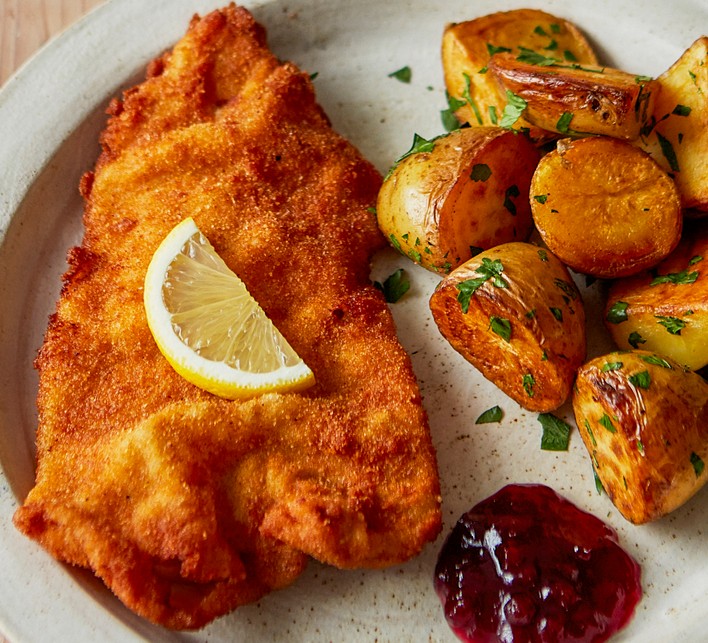
- Parsley potatoes or potato salad
- Optional: lingonberry jam
Equipment Needed
- Meat mallet or rolling pin
- Plastic wrap or parchment paper
- Three shallow dishes (for flour, egg, breadcrumbs)
- Large wide frying pan
- Tongs or slotted spoon
- Paper towels
- Thermometer (optional but helpful)
Step 1: Preparing the Meat
- Place each veal cutlet between two sheets of plastic wrap or parchment paper.
- Gently pound the meat, starting from the center and moving outward.
- Continue until the cutlet is about 3–4 mm thick.
Important notes:
- Pound gently; the goal is to thin the meat, not tear it.
- Even thickness ensures even cooking.
- Remove any remaining sinews, as they cause curling during frying.
Once flattened, lightly salt both sides of the cutlets just before breading.
Step 2: Setting Up the Breading Station
Prepare three shallow dishes in this order:
- Flour
- Spread evenly.
- No seasoning added.
- Egg Mixture
- Beat the eggs with milk or water until smooth.
- Do not season the eggs.
- Breadcrumbs
- Use dry, fine breadcrumbs.
- Do not press or season them.
Why this matters:
- Flour helps the egg stick.
- Egg binds the breadcrumbs.
- Unseasoned breadcrumbs keep the coating light and neutral.
Step 3: Breading the Schnitzel
Work with one cutlet at a time.
- Dredge the cutlet in flour.
- Shake off excess.
- Dip into the egg mixture.
- Ensure full coverage.
- Lay the cutlet into breadcrumbs.
- Gently turn to coat.
- Do not press the crumbs into the meat.
This loose coating is essential.
Pressed breadcrumbs will absorb fat and become heavy instead of crisp.
Place breaded cutlets on a plate and bread the rest.
Step 4: Heating the Fat
- Pour enough clarified butter or oil into a wide pan so the schnitzel can float slightly.
- Heat to 170–180°C.
How to test temperature without a thermometer:
- Drop in a breadcrumb.
- It should sizzle immediately and float.
The schnitzel must not touch the bottom of the pan for long. This floating effect creates the characteristic airy crust.
Step 5: Frying the Schnitzel
- Carefully place one schnitzel into the hot fat.
- Fry for about 2 minutes per side.
- Gently shake the pan and spoon hot fat over the top while frying.
What to look for:
- Golden, pale brown color
- Coating lifts slightly from the meat
- Small bubbles form under the breading
Do not overcrowd the pan. Fry one or two at a time depending on pan size.
Step 6: Draining and Resting
- Remove the schnitzel using tongs or a slotted spoon.
- Place briefly on paper towels to drain excess fat.
- Serve immediately.
Do not cover or stack the schnitzels. Steam will soften the crust.
Traditional Serving Suggestions
- Serve with lemon wedges on the side.
- Pair with parsley potatoes or Austrian potato salad.
- Lingonberry jam may be served separately.
- Garnish with fresh parsley if desired.
Never pour sauce over Wiener Schnitzel.
Sauce destroys the crisp coating and is considered incorrect in Austrian cuisine